Alert triage before checkout.
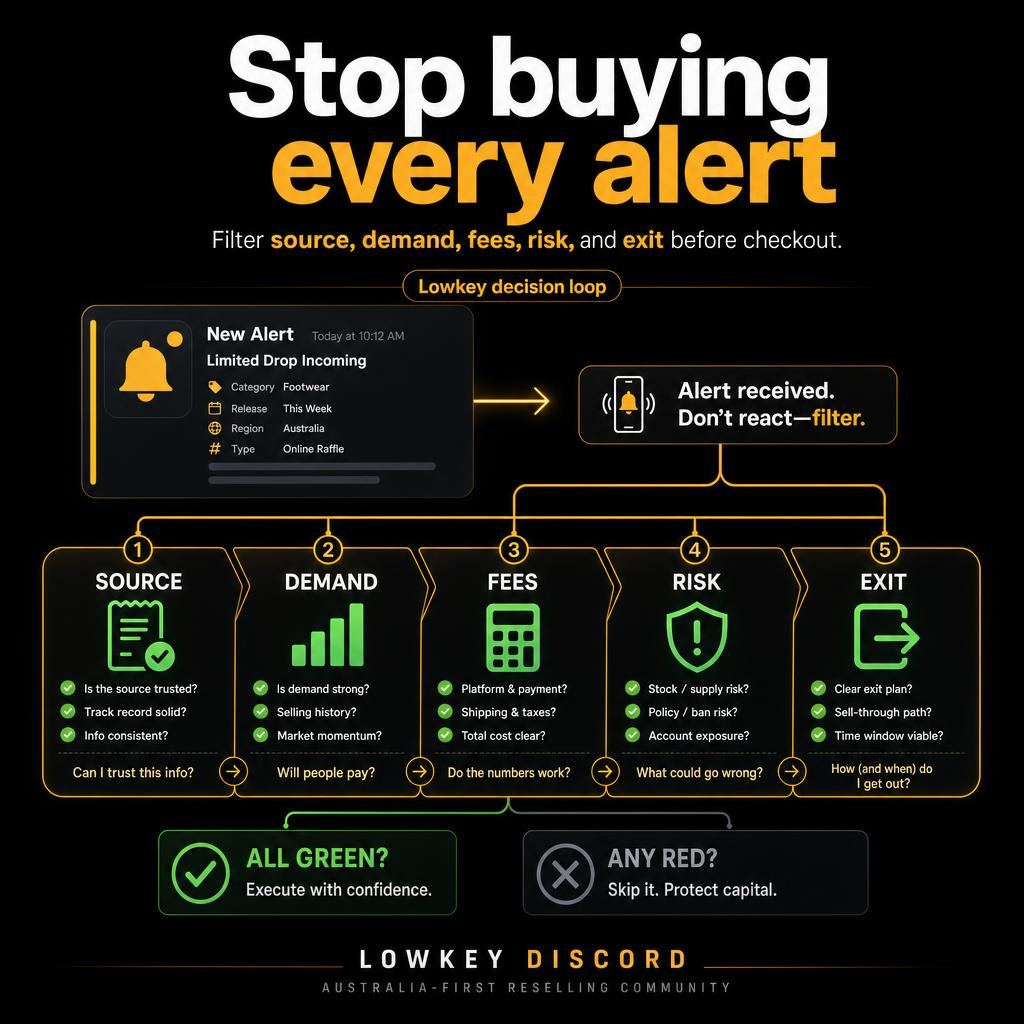
The first job is not buying faster. It is deciding whether the alert deserves attention. A useful alert is checked against source quality, local timing, demand depth, fee drag, and the exit route before cash moves.
Lowkey Discord is built for the moment before you buy: the alert hits, the stock is live, the price looks tempting, and you need to know whether the margin, demand, timing, and exit route make sense. Join for Australian-first reselling alerts, startup guidance, market channels, and staff support without pretending every drop is a guaranteed win.
Affiliate disclosure: this site may earn a commission if you join through our link. Results vary. Past reported member sales do not guarantee future outcomes.
A historical community claim, not a guarantee of your result.
A live community gives alerts more context and faster feedback loops.
Time in market matters because drops, stores, and buyers change constantly.
Always confirm current price and terms on the Whop checkout page.
This section is built like a carousel, not a video. Each panel gives the visitor one concrete resale idea to understand: filter the alert, read the workspace, follow the decision flow, subtract the boring costs, and score the risk before buying.

The first job is not buying faster. It is deciding whether the alert deserves attention. A useful alert is checked against source quality, local timing, demand depth, fee drag, and the exit route before cash moves.

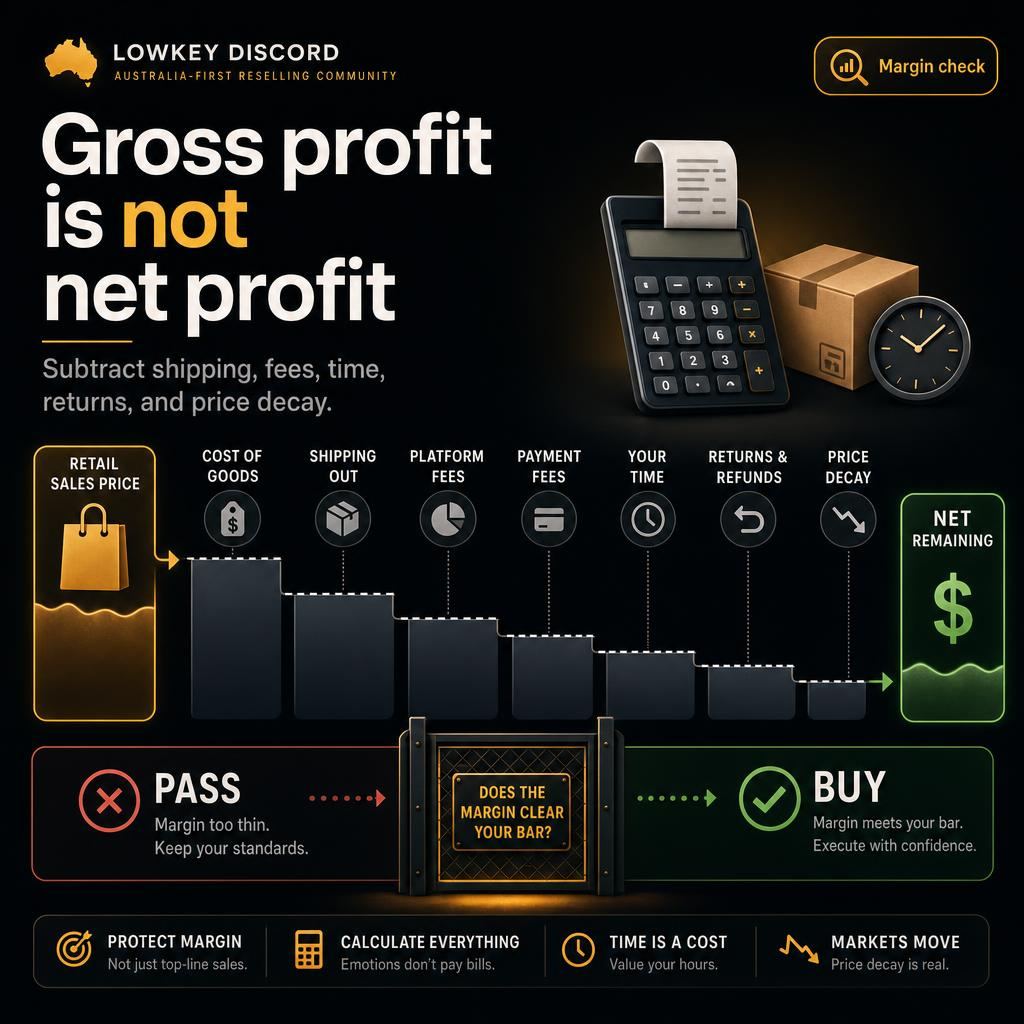
A product is not profitable because the resale price looks higher than retail. Real margin falls through shipping, platform fees, payment fees, time, returns, and price movement.

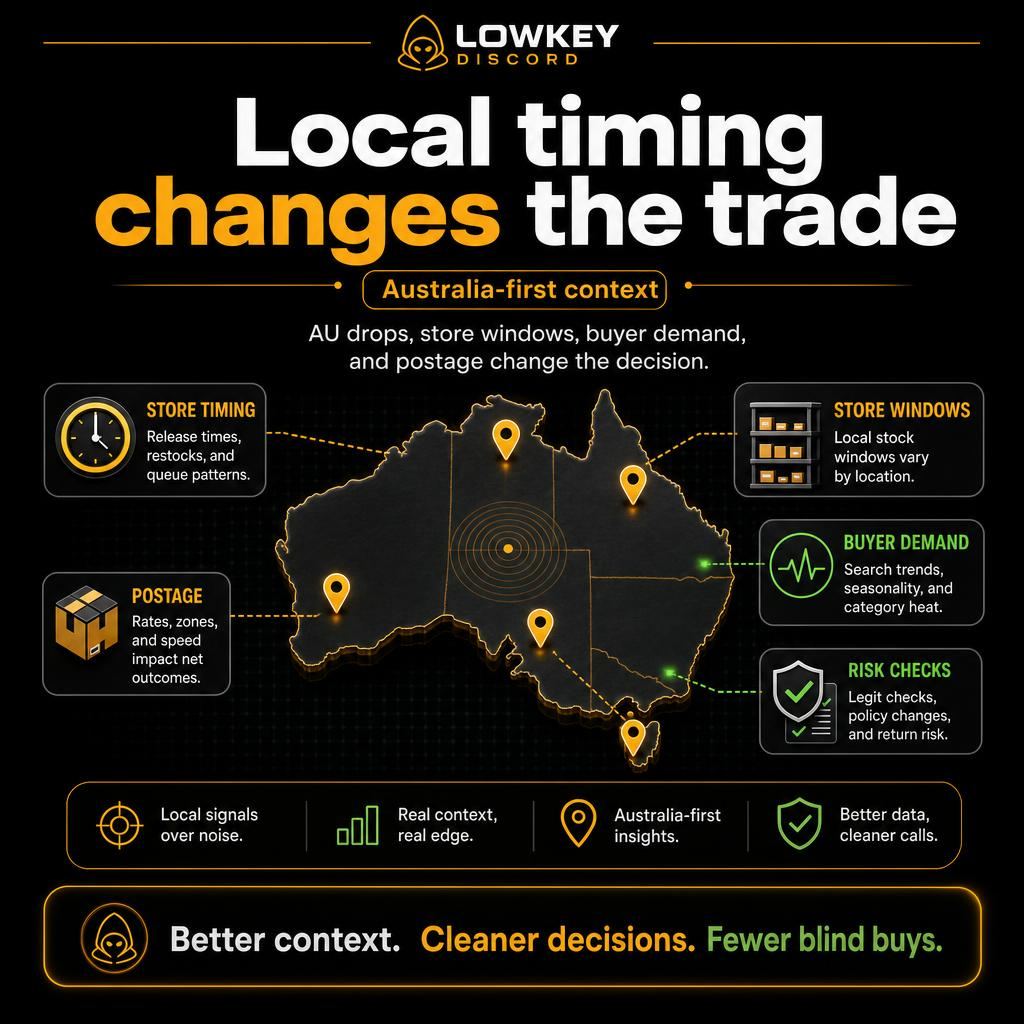
Australian timing, stock windows, buyer behavior, postage, and local event demand can change whether the same item is worth buying or worth skipping.

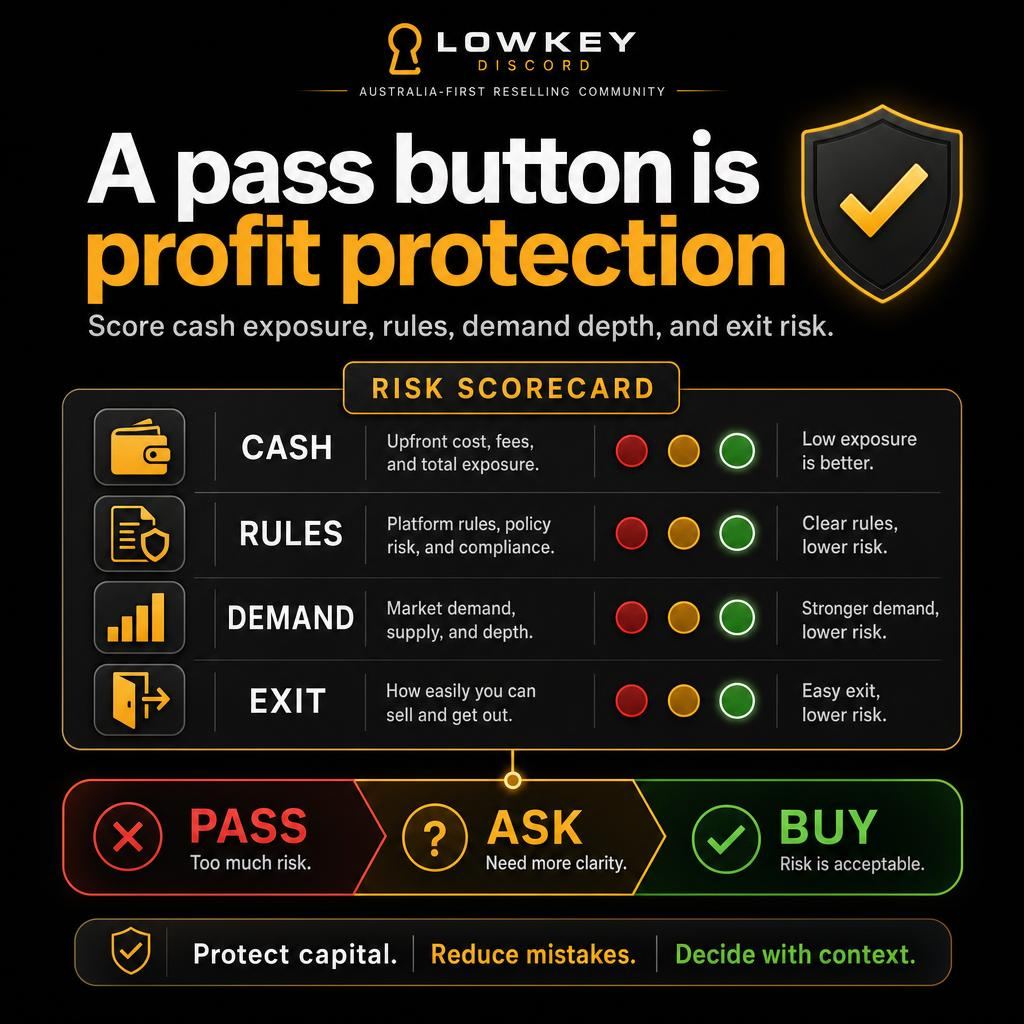
A beginner needs a pass button as much as a buy button. Score the opportunity on cash exposure, rule complexity, demand depth, and exit risk before committing money.

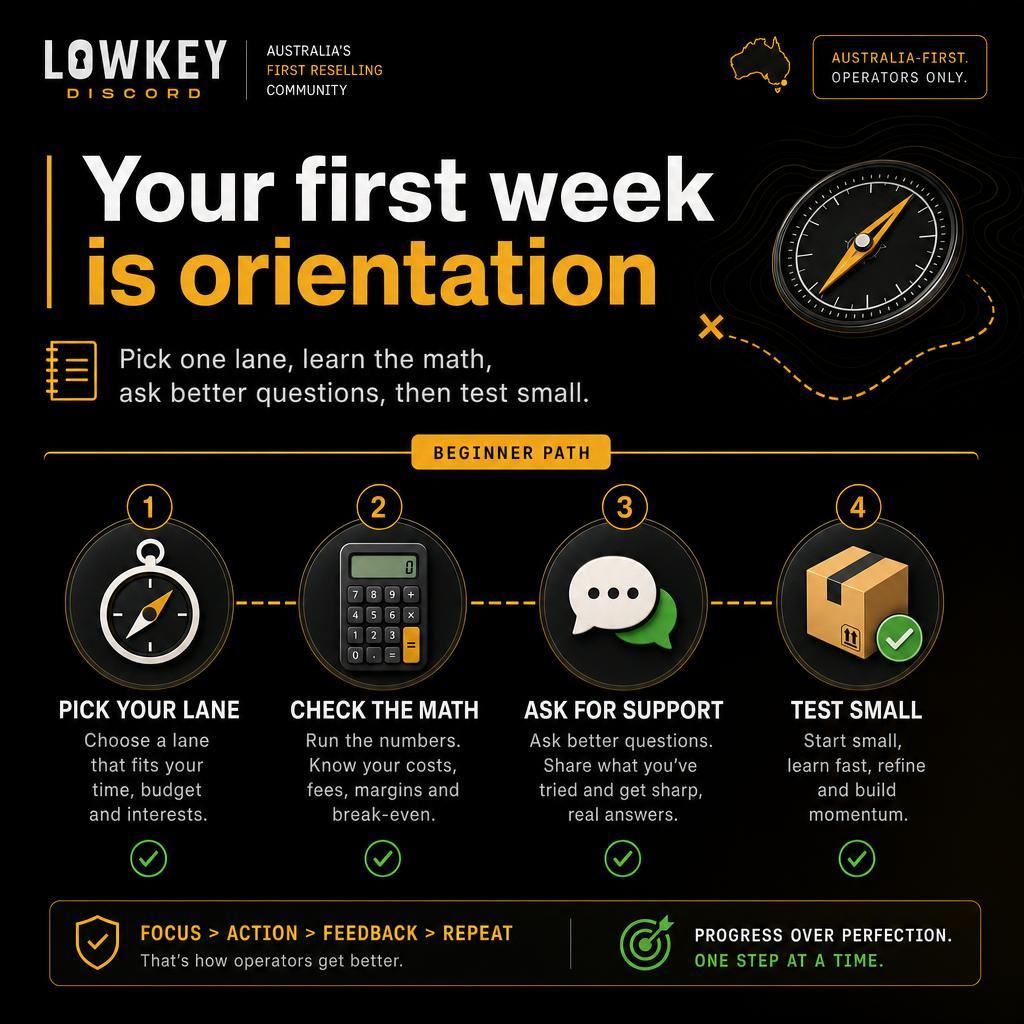
The first week should create orientation, not panic. Pick one lane, learn the math, ask better questions, then test small before scaling anything.
These panels turn the page into a visual operating manual. Each graphic shows one part of the Lowkey decision loop: filter the alert, check the source, run the net math, map the local edge, score the risk, and decide whether to buy or pass.
A product, offer, or presale appears.
Source, demand, price, and timing get reviewed.
Fees, postage, fuel, and time get subtracted.
Buy small, ask staff, watch, or pass.
AU drops can move before global groups notice.
Retailer behavior is not the same in every country.
Tickets and collectibles depend on local buyer pools.
Region-aware advice reduces beginner confusion.
Coins, slower collectibles, education channels.
Beginner offer, one-unit product test.
Thin margin, unclear fees, unfamiliar market.
Fast hype with no exit proof.
Find the map before acting.
Pick one lane, not six.
Read source, demand, math, and risk.
Clarify before scaling.
Turn experience into data.
The scorecard turns excitement into a slower, better next step.
You are at home with six tabs open. One says a product is sold out. One says the resale price is high. One person in a free chat says it is a lock. Another says the market is dead. The item is still available, but your confidence is not. That is the room most beginner resellers live in: not broke, not lazy, just buried under mixed signals.
The false belief is that profitable reselling is mainly about finding secret items. It is not. Finding the item is only the start. The real work is deciding whether the item survives fees, timing, demand, competition, and your own capital limits. A product can be "profitable" in someone else's screenshot and still be a bad buy for you.
The turn happens when you stop asking "what should I buy?" and start asking "what would make this a good decision?" That question changes everything. You stop chasing every alert. You begin looking for the source, the sell-through, the buyer, the margin, the rules, the exit route, and the downside if the price falls.
Lowkey's role is guide, not magic button. It gives you a map of active markets, channels that organize opportunities, alerts that arrive with context, and people you can ask before you scale. You still have to act. You still have to read. You still have to manage risk. But you are no longer trying to build the whole operating system from scratch.
A noisy reseller asks, "What is hot?" A calmer operator asks, "What evidence would make this buy worth the risk?"
The offer only makes sense if it raises the value of your decisions more than it costs. That means it has to increase the upside you can see, increase your belief that you can execute, shorten the time to a useful first result, and reduce the effort of sorting signal from noise. If it fails those four tests for your situation, you should skip it.
The dream is not joining another chat room. The dream is standing in a store, seeing a restock, and knowing whether the buy is worth the drive, the cash, and the risk. Lowkey sells a clearer decision moment: what dropped, why demand exists, what the expected resale window looks like, where members usually exit, and when walking away is smarter than buying.
A paid Discord only works if the buyer believes it can work for someone like them. Lowkey stacks several belief builders: a long-running Australian brand, a large reported member base, a startup guide, support tickets, release breakdowns, and channels dedicated to different markets. None of that removes risk, but it does reduce the feeling that you are starting from a blank page.
The first win is not always a sale. Sometimes it is learning which channels to mute, which alert terms matter, which beginner offers are available, or which Pokemon product has enough demand to deserve attention. The page is built around fast orientation because a member who knows where to look in hour one gets value sooner than a member wandering through channels for a week.
Reselling has hidden work: checking release pages, comparing fees, reading terms, finding buyer demand, estimating shipping, watching time zones, and asking whether the margin survives. Lowkey cannot remove execution, but it can shrink the research burden by putting the alert, the context, and the support path in one place.
The reason Lowkey can serve different member types is that reselling is not one market. A Pokemon flip, a ticket presale, a coin release, and a signup offer have different risks. Treating them the same is how beginners get hurt. The better path is choosing one lane, learning its rules, and only then widening your field of view.
Booster boxes, sealed products, restocks, local release timing.
Best for beginners who want tangible products and visible market demand.
Launch calendars, raffles, size demand, and sell-through notes.
Best for members who can move fast and understand sizing risk.
Presales, local demand spikes, event timing, and resale venue fit.
Best for members who can follow rules closely and avoid overbuying.
Mint releases, limited editions, collector demand, and exit timing.
Best for patient buyers who prefer lower-drama flips.
Funko, Labubu, Hot Wheels, and trend-based product alerts.
Best for people who can read short demand windows without chasing every fad.
Signup bonuses, casino promos, sportsbook promos, and offer checklists.
Best for cautious starters who want to learn process before holding stock.
Anyone can post a screenshot and call it an opportunity. The harder job is building a repeatable way to decide. The following six pieces are the actual mechanism: filtered signal, context, beginner sequencing, support, margin math, and local market knowledge. Each one lowers a different kind of doubt.
A bad alert says "buy this." A useful alert explains why the item exists, why demand may appear, what could break the trade, and where the buyer should check before spending money. The decision layer is the difference between noise and an operator system.
Free groups often reward speed and volume, so every post feels urgent. Lowkey is positioned around curation. The goal is fewer blind jumps and more filtered opportunities: product, source, demand, timing, margin, risk, and exit route.
Most new resellers lose money by starting in the wrong lane. They buy too many units, ignore fees, or copy someone with more cash. The startup path matters because the first week should teach the rules, not create a pile of inventory.
A support ticket or staff reply does not guarantee profit. It does change the experience from guessing alone to asking someone who has seen similar mistakes. That is valuable when the mistake is buying the wrong size, paying the wrong price, or misunderstanding an offer condition.
Every flip has ugly arithmetic: purchase cost, shipping, marketplace fees, payment fees, fuel, time, returns, and the chance the price falls. Lowkey makes more sense when you treat it as a margin discipline tool, not a hype machine.
A global group can miss local windows. Australian store timing, regional stock, event demand, and local buyer behavior are different from US-centered reselling feeds. Lowkey uses that geographic specificity as a real positioning advantage.
A $60 item selling for $120 looks simple until the boring parts arrive. Fees. Postage. Fuel. Time. Returns. Price decay. The mistake is counting the top-line number and calling it profit. The better habit is net-first thinking: if the spread does not survive costs, the flex was never real.
Illustrative math only. Always verify current market prices.
What you pay before shipping, fuel, or time.
A range, not a promise. Demand can move fast.
Marketplace fees, shipping materials, labels, and payment costs.
The number that matters more than the screenshot.
If the net is thin, the smarter move may be doing nothing.
The first week should make your behavior calmer. If you join and immediately chase the loudest alert, you have not bought a system; you have rented adrenaline. The better first week is slower at the start and faster later because you understand where to look and what to ignore.
Read the channel map first. Do not buy anything until you know where beginner alerts, free offers, support tickets, and market-specific channels live. The first hour is for orientation, not spending.
Choose Pokemon, offers, tickets, sneakers, coins, or collectibles. One lane creates learning. Six lanes create panic. The beginner mistake is treating every alert as equally relevant to your cash, location, and risk tolerance.
Write down retail cost, expected resale range, fees, shipping, time, platform risk, and exit marketplace. If the math does not survive on paper, it will not improve because you got excited in checkout.
Instead of asking "is this good?" ask "what would make this bad?" That question surfaces hidden costs: slow demand, tight margin, fragile condition, unclear terms, or a buyer pool that is smaller than the hype suggests.
A small action might be completing a verified offer, watching a release, pricing an item you already own, or buying a single low-risk unit. The goal is to learn the loop without betting your month on one idea.
Track what happened: buy price, sold price, fees, time spent, messages sent, and what you would change. A reseller who records reality improves faster than one who remembers only the wins.
Do not scale the first thing that feels good. Scale the thing you can explain, repeat, and survive if it goes wrong. That is the difference between a side hustle and a pile of hopeful receipts.
A good landing page should repel the wrong buyer. Lowkey is not a substitute for judgment, capital discipline, or reading terms. It is a way to shorten research loops, get organized alerts, and ask better questions before you act. That distinction matters because the member who expects certainty will be disappointed. The member who wants a sharper process is the better fit.
Many pings, uneven context, no clear beginner path.
Good education, slow timing, hard to apply to live drops.
Maximum control, maximum workload, no fast feedback.
Organized channels, staff support, AU-first alerts, and startup flow.
The fastest way to weaken a reselling page is to overpromise. Serious buyers know markets move. They know not every product sells. They know a member count is not a personal income forecast. So the page keeps the proof specific, then draws a line around it. That is not timid copy. It is trust-preserving copy.
No income guarantee. Member sales are historical reported figures, not your expected result.
No fake urgency. The CTA asks you to check the current Whop page, not believe a countdown timer.
No blind buying. The page pushes margin math, risk checks, and small first actions.
No universal fit. Australia-first context is a strength, but not every market suits every member.
No third-party logo bait. Visuals here explain the system without pretending to be official retailer material.
The page uses semantic infographics instead of decorative images: alert, source, demand, math, risk, and exit. Those six cues are the working checklist. If an alert cannot answer them, it is not ready to be treated like a buy signal.
Is this a real opportunity or just a loud post?
Where does the product, offer, or presale come from?
Who wants it, and how quickly does that demand fade?
Does the spread survive fees, postage, and time?
What breaks the trade if you are late or wrong?
Where can you sell it without guessing?
Good copy should answer the buyer's real doubts in plain language. If one of these answers makes you less excited, that is useful. It means the page is doing its filtering job before you spend money.
That is exactly why the first week should be structured. A complete beginner does not need advanced bot talk, private jargon, or ten markets at once. They need a startup guide, a few beginner lanes, a way to ask questions, and a rule that says: do not buy until the math is visible.
Capital matters, but it is not the only starting point. Smaller product flips, one-unit tests, and offer channels can teach the process before you hold expensive stock. The danger is not starting small. The danger is pretending a thin bank account can absorb unlimited mistakes.
Lowkey is strongest when the Australian context matters. International members may still find value in global sneaker content, offers, and general market education, but the page should not pretend every benefit is equal in every country. If your edge needs local AU timing, Australia is the center of gravity.
Then skip it. Reselling is not guaranteed income. Stock can vanish. Demand can fade. Fees can eat margin. Buyers can disappear. A serious community helps you make better decisions; it does not remove uncertainty from commerce.
Free alerts can be useful, but they often create the firehose problem. Too many posts, too little context, no clean beginner path, no strong accountability, and no one to ask when the alert meets your actual situation. The paid question is whether curation saves enough time, mistakes, and missed context to justify the fee.
Use the support path immediately. Ask where to start, which channels fit your budget, and what one beginner action makes sense this week. A paid community is wasted if you lurk silently while pretending confusion is research.
The worst version of a paid Discord is a slot machine with notifications. Ping. Click. Buy. Hope. Repeat. That is not an operating system; it is a faster way to make emotional decisions. The better version feels less exciting at the start because it asks you to think before the checkout page does. It asks whether the buyer is real, whether the resale price is current, whether the fee stack leaves room, and whether you can survive being wrong.
That is why the first week matters so much. A new member should not measure success by how many alerts they chased. They should measure it by how many bad buys they avoided, how quickly they found the right support channel, how clearly they can explain one market, and whether they wrote down the numbers before spending. Avoiding one poor inventory decision can be more valuable than forcing a flashy first sale.

You pass on a product because the fees make the net too thin. Nothing arrives in the mail. No screenshot gets posted. But you kept your cash for a cleaner setup.
You ask staff why an alert is strong instead of asking whether it is a guaranteed buy. The answer teaches you a pattern you can reuse next time.
You track buy price, sell price, time, fees, and mistake notes. After a month, your own records become proof of what fits your budget and temperament.
Join through Whop, read the current checkout terms, open the Startup Guide, pick one lane, and make the first week about learning the decision system. The right member does not need a promise that every alert wins. They need a sharper way to decide which alerts deserve action.
This is an affiliate page. We may earn a commission if you join through the link above. Reselling involves financial risk, market risk, platform risk, and execution risk. Confirm all prices, terms, and suitability before joining or buying inventory.